Many people today are trying the keto diet, which focuses on eating low carbs and high fats to help the body burn fat instead of sugar. But tracking this diet can feel confusing, especially for beginners.
That’s where MyFitnessPal comes in a popular app used to log meals, calories, and nutrients. Still, many users ask: does MyFitnessPal track keto diet properly? In this guide, you’ll learn about its tracking accuracy, how to set it up for keto, plus some useful tips and limitations to keep in mind.
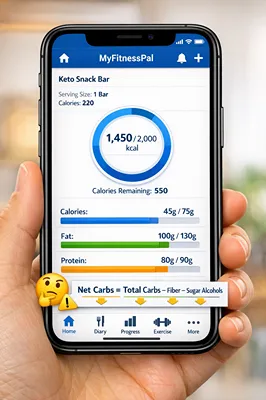
Yes, MyFitnessPal can track keto diet, but it mainly tracks total carbs, not net carbs automatically. You can still use it for keto by setting custom macros and manually calculating net carbs.
Does MyFitnessPal Track Keto Diet? (Direct Answer)
Yes, MyFitnessPal can track a keto diet, but it comes with a few limitations you should know.
The app mainly helps you track calories and macros like carbs, fats, and protein. This is useful for keto because your goal is to keep carbs low and fats high. You can log your meals and easily see how many carbs you’ve eaten during the day.
However, MyFitnessPal does not automatically track net carbs, which is very important for keto users. Net carbs = total carbs minus fiber (and sometimes sugar alcohols). You’ll need to calculate this manually or adjust your tracking settings.
So, while does MyFitnessPal track keto diet needs? Yes, it does the basics well—but you’ll need a little extra effort to make it perfect for keto tracking.
How MyFitnessPal Tracks Keto Diet
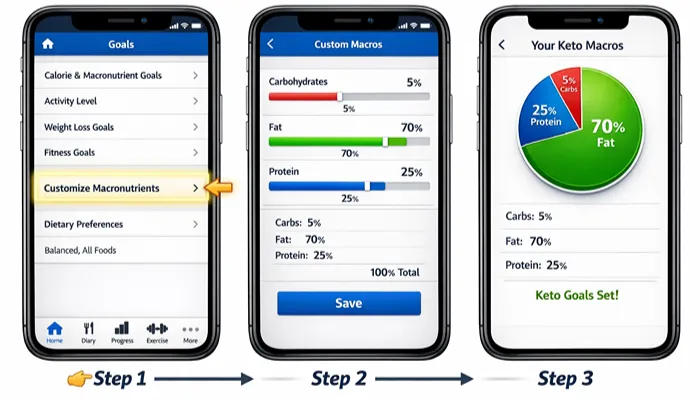
When it comes to keto tracking, MyFitnessPal mainly works by focusing on your daily macros—that means carbs, protein, and fat. You simply log the foods you eat, and the app automatically calculates how many grams of each macro you’ve consumed.
- Carbs: It tracks total carbs from your meals
- Protein: Helps you monitor muscle-supporting intake
- Fat: Shows how much fat you’re eating (important for keto)
Along with macros, it also keeps track of your total calories, so you can stay within your daily limit. This is useful because even on keto, calories still matter for weight loss or maintenance.
Another big advantage is its huge food database. You can search for almost any food—home-cooked or packaged—and log it quickly, which makes daily tracking simple and fast.
What It Tracks Well
MyFitnessPal does a great job tracking the basics you need:
- Calories
- Total carbs
- Fat and protein intake
What It Doesn’t Track Perfectly
However, it’s not fully designed for keto, so there are some gaps:
- It doesn’t automatically calculate net carbs
- It lacks deep keto-specific insights like ketosis tracking
📊 Here’s a quick overview:
| Feature | Supported |
|---|---|
| Calories | ✅ Yes |
| Total Carbs | ✅ Yes |
| Net Carbs | ❌ No |
| Fat Tracking | ✅ Yes |
If you’re new to tracking calories, you can also check our guide on How to Track Rice Calories in MyFitnessPal (No Confusion Guide)
How to Set Up Keto Diet in MyFitnessPal (Step-by-Step)
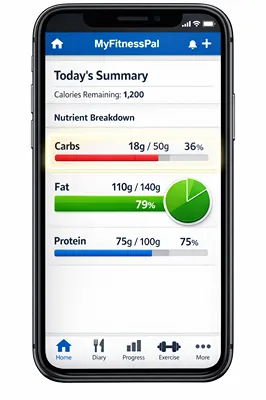
Setting up the keto diet in MyFitnessPal is actually pretty simple once you know where to look. Follow these easy steps to get started:
1. Open MyFitnessPal App
First, open the MyFitnessPal app on your phone or desktop. Make sure you are logged into your account so your data gets saved properly. This is where you’ll track everything you eat.
2. Go to Goals Section
Next, tap on the “Goals” section in the menu. This is where you can control your daily calorie and macro targets. It’s an important step because keto depends on the right balance of nutrients.
3. Set Custom Macros
Now, choose the option to set custom macros. Adjust them like this:
- 5–10% carbs (very low carbs for ketosis)
- 70–75% fat (your main energy source)
- 20–25% protein (for muscle and body function)
These settings help your body switch from burning carbs to burning fat.
4. Log Your Meals Daily
Start adding everything you eat into the app. Search for foods, scan barcodes, or create your own meals. Logging daily helps you stay consistent and aware of your carb intake.
5. Track Your Progress
Finally, check your progress regularly in the app. Look at your macro breakdown and see if you’re staying within your keto limits. This helps you adjust your diet if needed and stay on track.
Once you set this up, keto diet tracking in MyFitnessPal becomes much easier and more accurate.
You can scan food items using the barcode feature (learn more in our MyFitnessPal Barcode Scanner Guide)…
Problems with Using MyFitnessPal for Keto
Using MyFitnessPal for keto can be helpful, but it’s not perfect. There are a few common problems you should know about before relying on it fully.
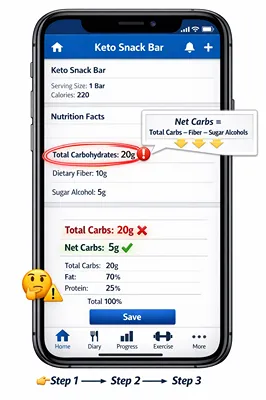
First, there is no automatic net carb calculation. Keto users usually track net carbs (total carbs minus fiber), but MyFitnessPal shows only total carbs by default. This means you have to calculate net carbs yourself every time, which can feel slow and annoying.
Second, the food database is not always accurate. Since MyFitnessPal allows users to add foods, some entries may have wrong calorie or macro values. If you’re not careful, you might log incorrect carbs or fats, which can affect your keto progress.
Third, manual tracking is required for better accuracy. You often need to double-check food labels, adjust serving sizes, and sometimes even create custom entries. This takes extra effort compared to apps made specifically for keto.
So, while MyFitnessPal for keto works, it needs careful use to avoid mistakes.
Tips to Track Keto Better in MyFitnessPal
Tracking keto in MyFitnessPal can be simple if you follow a few smart habits. These tips will help you stay accurate and avoid common mistakes.
👉 Calculate net carbs manually
MyFitnessPal shows total carbs, but keto depends on net carbs. So, subtract fiber (and sometimes sugar alcohols) from total carbs. For example, if a snack has 10g carbs and 4g fiber, your net carbs are 6g. This small step makes a big difference in staying in ketosis.
👉 Save custom foods/meals
If you eat the same meals often, save them. It saves time and improves accuracy. For example, if you have a daily keto breakfast like eggs and avocado, just log it once and reuse it every day.
👉 Always double-check entries
Not all food entries are correct. Some are user-added and may have wrong macros. Before logging, quickly verify calories and carbs. For instance, one entry for “almond flour” might show higher carbs than it actually has.
👉 Track consistently daily
Consistency is key. Even small snacks matter. If you skip logging a handful of nuts, your carb count can go off. Try to log everything you eat, every single day, to stay on track with your keto goals.
Best Alternatives for Keto Tracking
If you feel that MyFitnessPal is not fully meeting your keto tracking needs, there are a few great alternatives worth trying.
Carb Manager is one of the most popular keto-focused apps. It’s built specifically for low-carb diets, so you get clear net carb tracking, keto-friendly meal plans, and easy-to-read charts without much setup.
Cronometer is another strong option, especially if you care about accuracy. It tracks not just macros but also micronutrients like vitamins and minerals, which can be helpful for a balanced keto diet.
Compared to these, MyFitnessPal is more general. It works well for overall calorie tracking, but keto users may need to customize settings and double-check carb counts.
In simple terms, if you want a more “keto-ready” experience, Carb Manager or Cronometer can feel easier and more precise.
If you feel it’s not enough, you can explore better tools like those mentioned in our MyFitnessPal alternatives guide.
Is MyFitnessPal Good for Keto Beginners?
If you’re just starting your keto journey, MyFitnessPal can be a helpful tool. It’s great for basic tracking—you can easily log your meals, check your calories, and get a simple idea of your carb, fat, and protein intake. For beginners, this is often more than enough to build awareness and stay on track.
However, it’s not perfect for strict keto followers. The app doesn’t focus specifically on net carbs unless you customize it, and some food entries may not always be accurate. So, if you’re trying to follow keto very strictly, you might feel a bit limited.
Who should use it?
- Beginners ✔️ – Easy to use and understand
- Advanced keto users ❌ – May need more detailed tracking tools
Overall, it’s a solid starting point, but not the ultimate keto solution.
Conclusion
So, does MyFitnessPal track keto diet? Yes, it does—but with some limits. You can log your meals, check macros, and stay on track, but it may not be perfectly designed for strict keto users. That’s why making a few manual adjustments really helps improve accuracy.
If you’re just starting, MyFitnessPal is still a great tool to learn and manage your diet. Try it yourself and see how it works for your routine. And if you feel it’s not enough, you can always explore more advanced keto-focused apps later.